Writing · Templates
Wedding food information wording for guests
Wedding food information should tell guests which function includes a meal, roughly when it will be served and whom to contact about a serious dietary need. Keep the wording factual, separate confirmed arrangements from requests, and place each note with the function it belongs to.
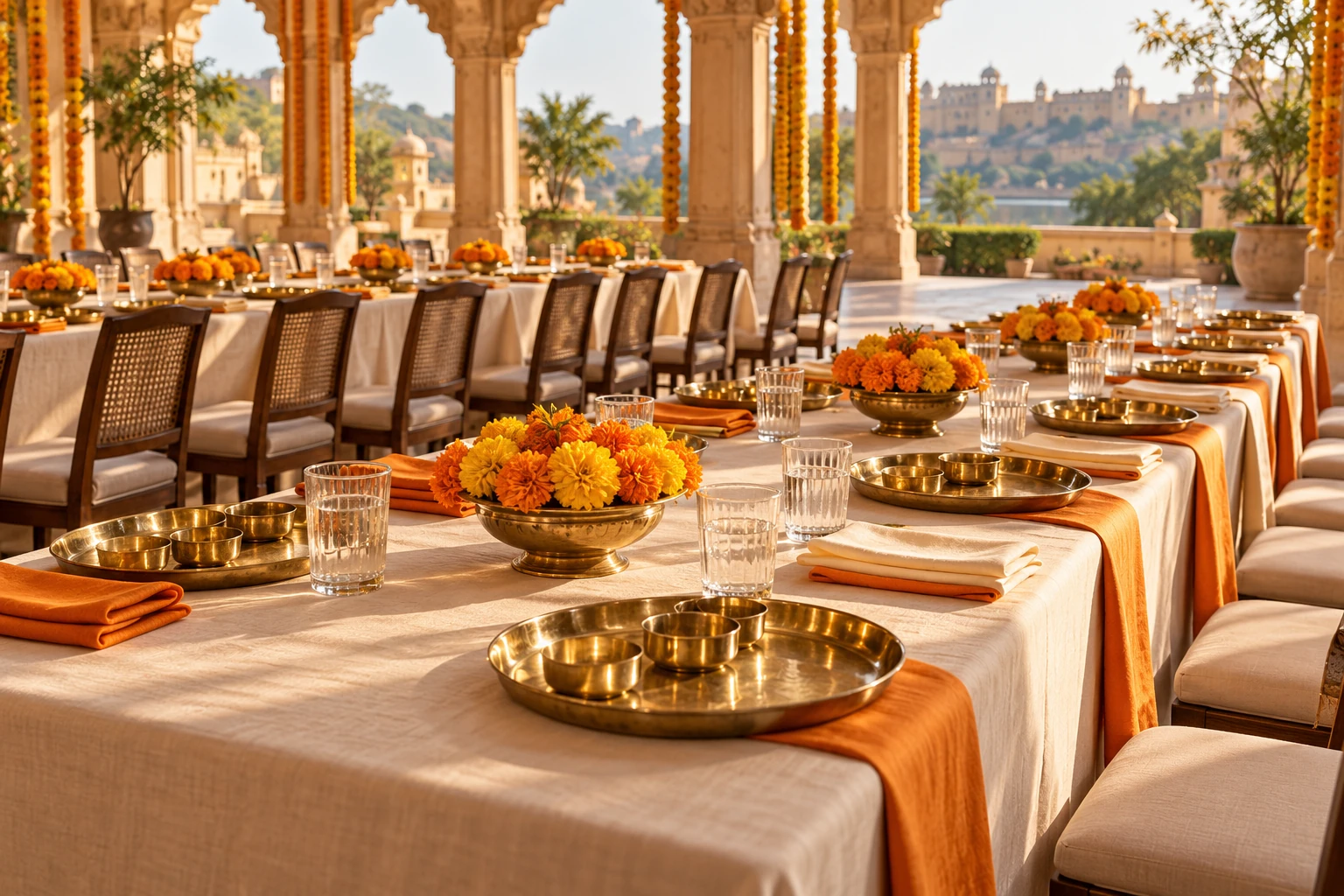
Wedding food information should tell guests which function includes a meal, roughly when it will be served and whom to contact about a serious dietary need. Keep the wording factual, separate confirmed arrangements from requests, and place each note with the function it belongs to.
“Dinner will be served” leaves several questions open. Is it after the Sangeet performances or before them? Does a late-evening reception include a full meal? Should a guest with an allergy contact the family, the venue or nobody yet? A short practical note can answer those questions without publishing the entire menu.
What should wedding food information tell guests?
Start with what has been confirmed. Name the function, the meal and the useful timing cue. If the service time depends on the programme, use a moment guests can recognise rather than guessing a precise minute.
A complete note may include:
- whether the function includes breakfast, lunch, dinner or light refreshments;
- when service begins, or what programme moment it follows;
- whether guests need to act before a stated deadline;
- one contact for allergies or medically important dietary needs;
- any limitation the caterer has explicitly confirmed.
Do not list every dish simply to make the page feel complete. A menu can change while the useful promise — lunch after the ceremony, for example — remains stable.
Which meal wording can you copy for each function?
For a daytime Haldi or Mehendi:
Lunch after the Haldi
Lunch will be served at [time], after the Haldi. If you need to tell us about a serious food allergy, please contact [name and number] by [date].
For a Sangeet where dinner follows the programme:
Dinner at the Sangeet
Dinner will be served after the performances, from approximately [time]. Please contact [name] by [date] about any medically important dietary requirement.
For a reception with refreshments before the meal:
Reception food and timing
Welcome refreshments will be available from [time], followed by dinner at approximately [time]. For a serious allergy or dietary need, contact [name and number] before [date].
Replace every bracketed field. If the caterer has not confirmed the service format or timing, remove that sentence rather than presenting an estimate as settled.
How should you ask about dietary requirements?
Ask only for information that somebody has agreed to receive and act on. Give guests a named contact and a deadline connected to the caterer’s planning. “Let us know your dietary requirements” is too vague when nobody knows where to send the answer.
Use calm, specific wording:
If you have a food allergy or medically important dietary requirement, please contact [name] at [number] by [date]. We will share the information with the caterer and confirm what can be accommodated.
Do not promise an allergen-free kitchen, complete separation or a particular substitute unless the venue or caterer has confirmed it. Also avoid implying that a wedding website RSVP collects meal choices or dietary preferences unless the actual setup has been checked; that behaviour is not established for Vowframes.
When do different functions need separate food notes?
Write one note per function whenever the meal, time, venue or invited list changes. A family lunch after the Mehendi and dinner at the reception are separate plans, even if the same caterer serves both.
Vowframes treats every function as its own event with its own venue, timing and invited list. The same wedding link shows a guest only the functions they are invited to. Keep the food note beside the relevant function so a reception-only colleague is not told about a private Haldi lunch, while a relative attending several days can see each meal in context.
Do not use “food will be available throughout the wedding” when that sentence really applies to one venue or one day. Guests plan travel and medication around meals; broad wording can be less helpful than a short, accurate line.
What should you verify before publishing the meal information?
Read the final note back to the caterer, venue or family member responsible for that function. Confirm the meal, service window, contact, deadline and any accommodation language. Remove old timing rather than leaving a correction beside it.
Then open two contrasting guest views: one for someone attending several functions and one for a guest invited to only one. Each person should see food information that matches their actual invitation. Finally, hand the wording to somebody outside the planning group. They should be able to say whether a meal is included, when to expect it and whom to contact without searching a WhatsApp thread.