
Writing · Templates
Indian wedding website welcome message examples
An Indian wedding website welcome message should greet guests, name the couple, and point them to the schedule and RSVP without retelling the whole relationship. Use one of the short examples below, then let each event page carry its own venue, timing and practical details.
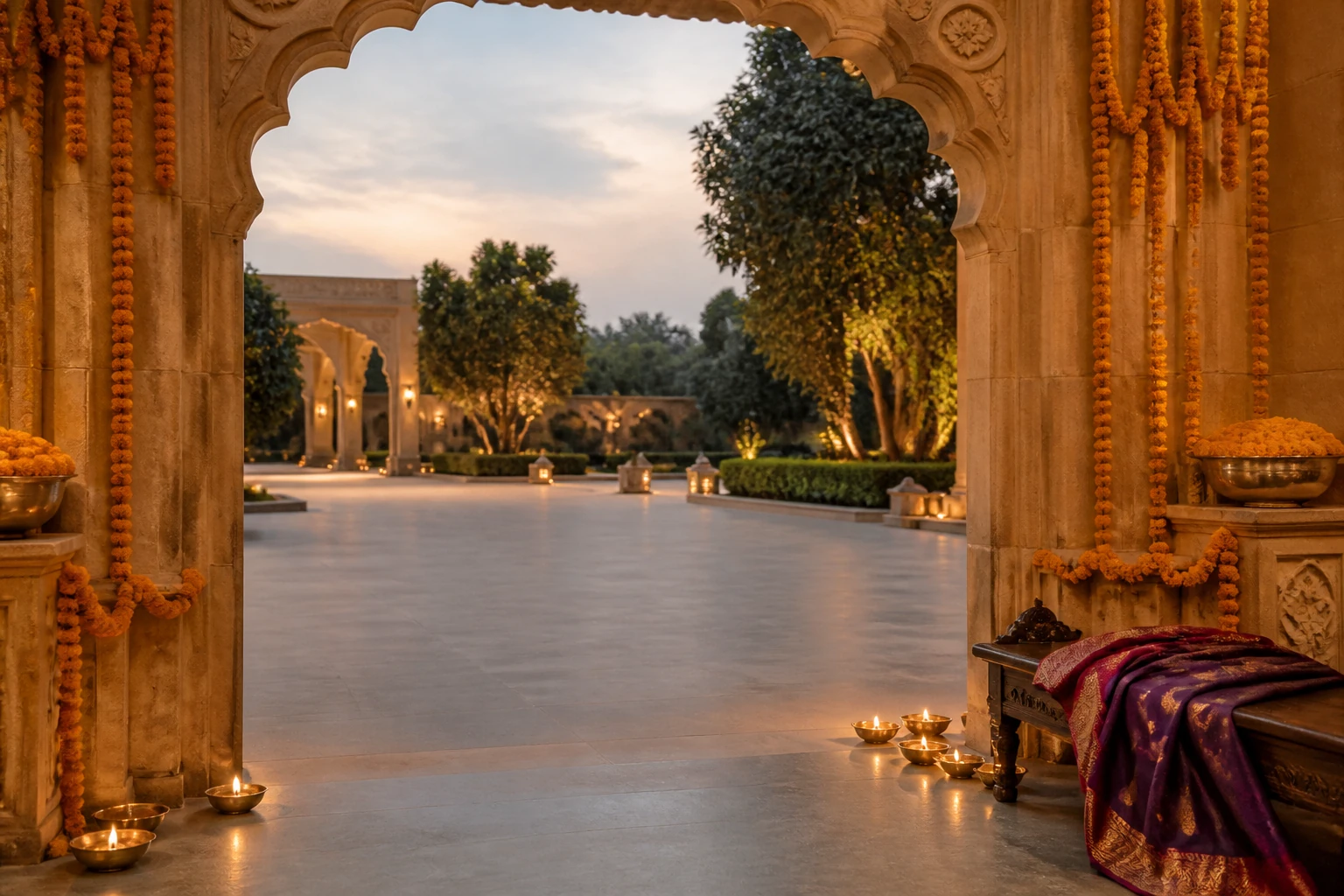
An Indian wedding website welcome message should greet guests, name the couple, and point them to the schedule and RSVP without retelling the whole relationship. Use one of the short examples below, then let each event page carry its own venue, timing and practical details.
The homepage has a small job. It should reassure guests that they are in the right place and tell them what to do next. The Mehendi address, Sangeet arrival time and reception notes belong with those functions, where they are easier to find again.
What should an Indian wedding website welcome message include?
Keep it to three parts: a greeting, one sentence about the celebration, and a direction to the useful information. Name the couple as guests know them. If both families are hosting, you can acknowledge them without turning the opening into a formal invitation card.
A simple structure is:
Welcome to [name] and [name]’s wedding website. We are excited to celebrate with you across [dates or city]. Please check your invited events below and confirm your attendance by [RSVP date].
Do not squeeze the complete itinerary into this paragraph. Guests returning on Friday afternoon should be able to move straight from the greeting to the function they need.
Which short welcome message fits your tone?
For a direct, practical opening:
Welcome — we are so glad you will be part of our wedding. You will find the schedule, venues and RSVP for the functions on your invitation here. Please confirm your plans by [date], and check back before travelling for the latest details.
For a family-hosted celebration:
Together with our families, we are delighted to welcome you to [name] and [name]’s wedding celebrations. This site has the details for the functions included in your invitation. Please review your schedule and RSVP by [date].
For a warmer but still concise version:
We cannot wait to celebrate with you. Our wedding begins with [first function] and continues through [final function]. Your invited events, timings and venues are gathered here, along with one RSVP for your plans.
Replace every bracketed field. A template marker left on the homepage is more noticeable than a line you chose not to include.
How do you introduce several wedding functions without listing everything?
Describe the shape of the celebration, then leave the exact sequence to the schedule. “Join us across three days in Jaipur” gives context. Repeating five dates, addresses and dress notes in the welcome message creates a second itinerary that can go stale.
Vowframes treats every function as its own event with its own venue, timing and invited list. The same wedding link shows a guest only the functions they are invited to. That means the welcome can stay broad while the useful detail remains specific to each person.
If some guests attend the full celebration and others come only to the reception, avoid phrases such as “we will see you all week.” Use “we look forward to celebrating with you” instead. It works for every invitation without suggesting access to another function.
What should the message ask guests to do next?
Choose one primary action. Before the response deadline, ask guests to RSVP. Closer to the wedding, point them to their schedule and current venue details. After the wedding, the gallery may become the useful destination.
A guest invited to several functions answers once in one flow for all the events on their invitation, while responses are recorded per function. Wording such as “Please confirm your plans for each invited event” is clear about the information needed without suggesting that the guest must complete several separate forms.
Avoid promising reminders or asking guests to reply in a family group. The wedding link can be shared by WhatsApp, SMS or email; the page itself should remain the dependable place to return to.
What should you remove before publishing the homepage?
Cut any paragraph that delays the schedule without helping a guest. A long account of how the couple met can live in its own section. Instructions for parking, clothing, maps and day-of contacts should sit beside the relevant function or in the FAQ.
Then read the welcome as three different people: a relative attending every day, a colleague invited only to the reception, and a guest unfamiliar with the customs. None should be told they are attending an event outside their invitation, and all three should know where to look next.
Finally, check the names, dates and RSVP deadline against the rest of the site. A beautiful greeting with an old deadline creates more confusion than a plain sentence with the current one. The welcome is ready when it gets out of the way and lets the wedding website do the practical work.